

-
We’re On Call 24/7 : +8613538296050
-
E-mail : anna@rohoconnector.com
We’re On Call 24/7 : +8613538296050
E-mail : anna@rohoconnector.com
As 5G networks densify and small cell deployments accelerate, the NEX10 connector interface has emerged as a compact, high-performance solution for space-constrained RF systems. Standardized under IEC 61169-71 for 50-ohm RF coaxial connectors with a 5.0 mm inner diameter outer conductor, the NEX10 interface offers a 50% smaller footprint than the widely used 4.3-10 connector, enabling dramatically higher port density on radios, antennas, and filter outputs.
A key practical question for engineers and installers is: what coaxial cables are typically terminated with NEX10 connectors? The answer depends on the application—whether it is a short jumper inside a remote radio head or a low-loss feeder connection at an antenna port.
A Connector Designed for Compact, Low-PIM Applications
The NEX10 interface was developed to address the evolving needs of small cell and distributed antenna systems (DAS). Its key attributes include:
Frequency range: DC to 20 GHz
Impedance: 50 Ω
PIM performance: Better than –166 dBc (typical)
Power handling: Approximately 100 W at 2 GHz (at 85°C)
Flange height: 12.7 mm minimum
Environmental protection: IP68 when mated
Coupling options: Screw, hand-screw, and push-pull (quick lock)
These characteristics make NEX10 ideal for applications requiring PIM stability in a compact size, including small cells, MIMO antennas, and in-building DAS.
Commonly Used Coaxial Cables with NEX10 Connectors
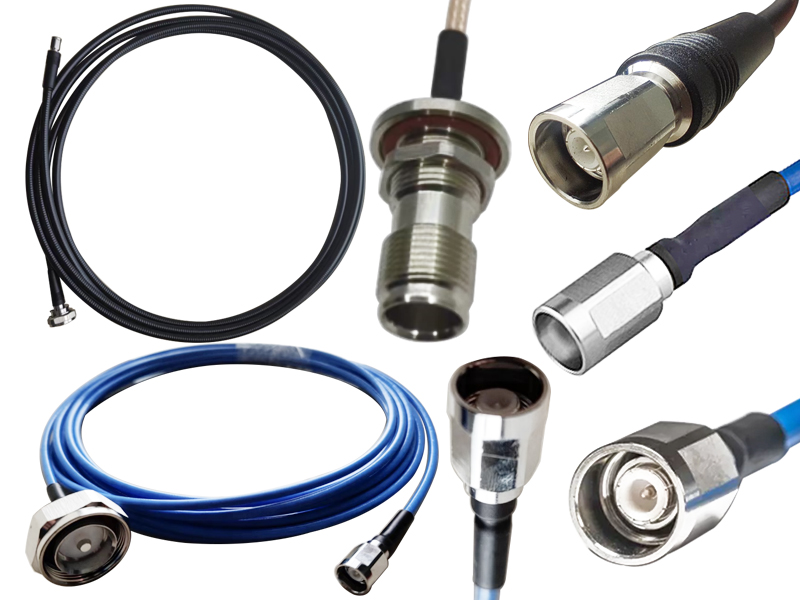
The NEX10 interface is optimized for a specific range of cable sizes, primarily focusing on small-diameter flexible and corrugated cables. The following cable families are most commonly paired with NEX10 connectors.
1. 1/4-Inch Superflexible Corrugated Cables
The most widely used cable type with NEX10 connectors is 1/4-inch superflexible corrugated cable. This cable offers an excellent balance of low loss, flexibility, and power handling, making it ideal for jumper connections between remote radio heads (RRHs) and antennas, as well as short feeder runs.
Typical 1/4-inch superflexible cables compatible with NEX10 connectors include:
| Cable Designation | Characteristics | Typical Applications |
| SPP-250-LLPL | PTFE dielectric, 76% velocity of propagation, corrugated | Low-PIM jumpers, plenum installations |
| SPF-250 | Corrugated, low-PIM construction | General-purpose jumpers |
| SPO-250 | Corrugated, low-PIM | Outdoor-rated assemblies |
| 1/4" Superflexible | 50 Ω corrugated, flexible | Tight-space installations, bulkhead connections |
These cables are available in standard and low-PIM versions, with PIM performance typically better than –160 dBc. Cable assemblies using these cables operate to approximately 5.8–6 GHz and achieve VSWR of 1.4:1 to 1.5:1.
2. 3/8-Inch Corrugated Cables
For applications requiring slightly lower loss and higher power handling than 1/4-inch cable, 3/8-inch corrugated cable is commonly used with NEX10 connectors. These cables are well-suited for medium-length jumper runs and field-fit connections. The NEX10 interface portfolio includes connector options optimized for 3/8-inch corrugated cables.
3. 1/2-Inch Flexible and Feeder Cables
While NEX10 connectors are primarily optimized for 1/4-inch and 3/8-inch cables, they are also available for 1/2-inch flexible and feeder cables. These larger cables are used for longer jumper runs or as feeder connections where lower loss is required. NEX10 connector options for 1/2-inch cables are available in screw-type configurations with IP68 sealing.
4. Flexible Cables (TFT-402, RG-Series)
For test and measurement applications and shorter interconnects, NEX10 connectors are also used with flexible cables such as:
| Cable Type | Characteristics | Typical Applications |
| TFT-402 | Flexible, low-PIM, plenum-rated | Test leads, short jumpers |
| TFT-5G-402 | Flexible, low-PIM, optimized for 5G | 5G test and measurement |
| RG-142 | Flexible, 50 Ω | General-purpose RF interconnects |
| RG-223 | Flexible, 50 Ω | Test and measurement |
These cables are typically used where maximum flexibility is required, such as in test benches or where cable routing is complex.
5. Semiflex Cables (UT-85, UT-141)
NEX10 connectors are also compatible with semiflex cables such as UT-85 and UT-141. These cables offer excellent shielding and phase stability but are less flexible than corrugated cables. They are typically used in equipment racks or test fixtures where the cable is not subject to movement.
Summary of Common Cable Pairings
| Cable Category | Typical Size / Type | Common Applications | Key Characteristics |
| 1/4" Superflexible | SPP-250-LLPL, SPF-250, SPO-250 | RRH-to-antenna jumpers, DAS | Excellent balance of loss and flexibility; PIM ≤ –160 dBc |
| 3/8" Corrugated | Various low-PIM types | Medium-length jumpers | Lower loss than 1/4"; higher power handling |
| 1/2" Flexible/Feeder | SCF12-50J, 1/2" Superflex | Longer jumper runs, feeder connections | Low loss; IP68 sealed connectors available |
| Flexible (TFT-402) | TFT-402, TFT-5G-402 | Test and measurement, short interconnects | Maximum flexibility; plenum-rated options |
| Semiflex (UT-85/141) | UT-85, UT-141 | Equipment racks, test fixtures | Excellent shielding; phase-stable |
Selection Considerations
When choosing a coaxial cable for a NEX10 connector, engineers should evaluate the following factors:
| Factor | Considerations |
| Frequency range | NEX10 operates to 20 GHz. Ensure the cable's loss is acceptable at your highest operating frequency. |
| Power handling | 1/4" cable is suitable for moderate power; 3/8" and 1/2" cables handle higher power levels. |
| PIM performance | For multi-carrier cellular systems, select low-PIM cable with PIM ≤ –160 dBc. |
| Flexibility | 1/4" superflexible is ideal for tight spaces; 1/2" is stiffer and requires careful routing. |
| Environmental conditions | Outdoor installations require UV-resistant, water-blocking jackets and IP68-rated connectors. |
| Connector attachment | Ensure the NEX10 connector is designed for the specific cable type and diameter (clamp, crimp, or solder). |
| Application | For blind-mate and multi-coax applications, 1/4" corrugated cable is the standard choice. |
Installation Best Practices
To achieve the best performance from a NEX10 connector and cable assembly:
Use the correct stripping dimensions: Each cable and connector pair has specific strip lengths. Follow the manufacturer's instructions precisely.
Maintain proper torque: NEX10 connectors typically require 1.5 Nm of torque for screw-type coupling. Over-torquing can damage threads; under-torquing can cause PIM and signal loss.
Keep connectors clean: Contamination is a leading cause of high PIM. Clean mating surfaces with isopropyl alcohol before connection.
Weatherproof outdoor connections: Use weather protection boots or self-amalgamating tape to seal the connector-cable junction. NEX10 connectors are IP68-rated when properly mated.
Support the cable: Avoid placing mechanical stress on the connector. Use cable ties and hangers at recommended intervals.
Test after installation: Verify VSWR and, for cellular sites, PIM performance to ensure the assembly meets specifications.
Conclusion
The NEX10 connector is a compact, high-performance interface that has become a preferred solution for modern small cell and DAS deployments. It is most commonly terminated on 1/4-inch superflexible corrugated cable for jumpers and short interconnects, with 3/8-inch and 1/2-inch corrugated cables used for longer runs and higher power applications. Flexible cables such as TFT-402 and semiflex cables like UT-85/141 are also compatible for test and equipment applications.
When selecting a cable for a NEX10 connector, always verify 50 Ω impedance, frequency range, power handling, PIM performance, and environmental suitability. With the right cable and proper installation, a NEX10 connector assembly will deliver reliable, low-loss, and interference-free performance in the most demanding RF environments—from dense urban small cells to in-building DAS networks and beyond.