

-
We’re On Call 24/7 : +8613538296050
-
E-mail : anna@rohoconnector.com
We’re On Call 24/7 : +8613538296050
E-mail : anna@rohoconnector.com
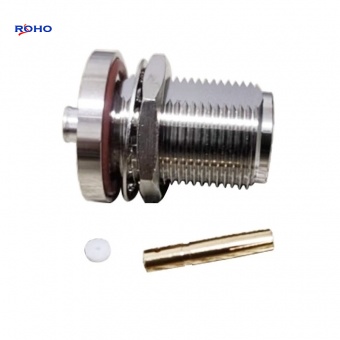
The N-type connector, designed by Paul Neill of Bell Labs in the 1940s, has become a cornerstone of RF and microwave systems. Featuring a threaded, weatherproof coupling mechanism and reliable performance up to 11 GHz (and up to 18 GHz for precision versions), it is widely used in cellular infrastructure, radar, satellite communications, and test instrumentation.
One of the key advantages of the N-type interface is its broad compatibility with a wide range of coaxial cables. This versatility allows engineers to select the optimal cable for their specific application—whether prioritizing low loss, flexibility, or cost—while maintaining a consistent connector interface. This article provides an overview of the coaxial cable families that commonly terminate with N-type connectors.
Classification of Compatible Cables
N-type connectors are manufactured with different termination styles—solder, clamp, or crimp—to accommodate various cable diameters and constructions. Cables compatible with N-type connectors generally fall into several categories:
1. RG-Series Cables (Military Designation)
The RG (Radio Guide) series is the most widely recognized family of coaxial cables. Different N-type connector variants are designed to accommodate specific RG cable sizes:
| Cable Type | Typical Applications | Key Characteristics |
| RG-8 / RG-8A/U | Amateur radio, base stations, low-frequency communications | Large diameter, low loss at HF/VHF |
| RG-58 / RG-58A/B/C/U | General-purpose RF, test leads, short interconnects | Flexible, small diameter, economical |
| RG-141 / RG-141A/U | Microwave applications, precision test | Low-loss, semi-flexible |
| RG-142 / RG-142A/U | Military and aerospace applications | High-temperature, low-loss |
| RG-174 | Compact, low-power applications | Very thin and flexible |
| RG-213 / RG-213/U | High-power amateur radio, broadcast | Low-loss, robust, handles high power |
| RG-214 / RG-214/U | High-power, double-shielded applications | Low-loss with extra shielding |
| RG-223 | Test equipment, high-frequency applications | Low-loss, semi-flexible with solid dielectric |
| RG-225 | Specialized military applications | Low-loss, high-performance |
| RG-303 | Aerospace and defense applications | High-temperature, low-loss |
| RG-393 | High-performance military applications | Low-loss, rugged |
| RG-400 | High-reliability test and aerospace applications | Double-shielded, high-temperature |
2. LMR-Series Cables (Low-Loss, High-Performance)
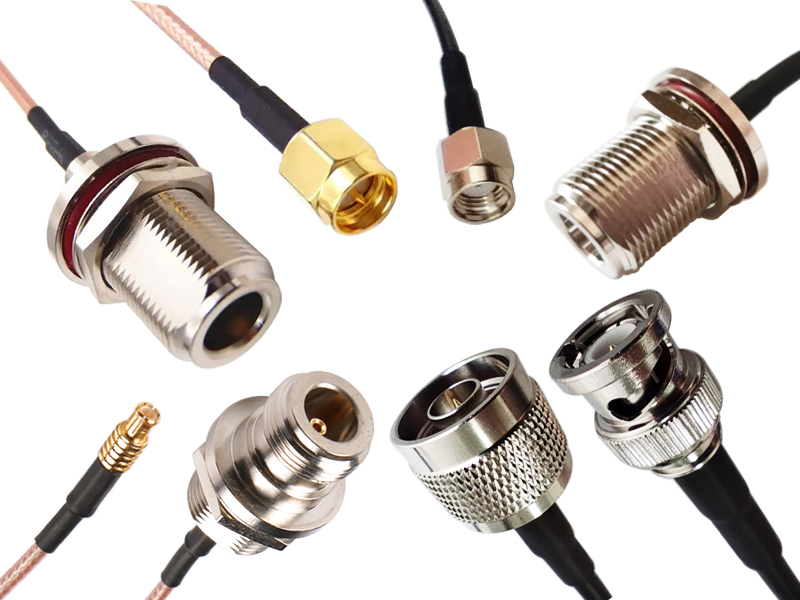
The LMR (Low-Loss, Multi-purpose, Reliable) series, developed by Times Microwave, offers excellent performance with lower attenuation than traditional RG cables. Common LMR cables compatible with N-type connectors include:
| Cable Type | Typical Applications | Key Characteristics |
| LMR-195 | Cellular, GPS, Wi-Fi, short jumper cables | Flexible, low-loss alternative to RG-58 |
| LMR-200 | Medium-length antenna feeds, in-building distribution | Low-loss, similar to RG-58 but with better performance |
| LMR-240 | Medium-length runs, wireless infrastructure | Low-loss, flexible, replacement for RG-8X |
| LMR-400 | Long cable runs, base station feeds, high-performance systems | Very low-loss, excellent for long-distance runs |
3. Belden Cables
Belden manufactures a wide range of high-quality coaxial cables, many of which are compatible with N-type connectors:
| Cable Type | Typical Applications | Key Characteristics |
| Belden 7806A | High-performance RF applications | Low-loss, high-quality construction |
| Belden 8219 | Broadcast and communications | Standard RG-59/U equivalent |
| Belden 8240 | Plenum-rated applications | Low-loss, plenum-rated |
| Belden 8259 | RG-58/U equivalent | Flexible, general-purpose |
| Belden 9201 | High-frequency test applications | Precision, low-loss |
| Belden 9907 | High-performance RF applications | Low-loss, high-quality |
| Belden 9310 / 9311 | High-frequency, precision applications | Low-loss, excellent shielding |
4. Additional Compatible Cable Types
Beyond the major families, N-type connectors are also compatible with various other coaxial cables:
| Cable Type | Typical Applications | Key Characteristics |
| RG-8X | Compact amateur radio installations | Thin, low-loss version of RG-8 |
| RG-55 | Military applications | Flexible, 50 Ω |
| RG-87 | High-frequency applications | Low-loss, air-dielectric |
| RG-144 | Communications systems | Low-loss, medium-duty |
| RG-165 | General-purpose RF | Standard 50 Ω cable |
| RG-215 / RG-216 | High-performance systems | Low-loss, double-shielded |
| PSF 1/4 M | Specialized communications | Low-loss, flexible |
| URM 43 / URM 67 / URM 76 / URM 91 | Military and NATO applications | Various sizes and performances |
The Importance of Impedance Matching
N-type connectors are available in both 50 Ω and 75 Ω impedance versions. The 50 Ω variant is standard for telecommunications, wireless infrastructure, test equipment, and most RF applications. The 75 Ω variant is used primarily in video broadcast and CATV systems.
When selecting a cable and connector combination, it is critical to match impedance. A 50 Ω connector on a 75 Ω cable (or vice versa) introduces impedance mismatch, resulting in signal reflections, increased VSWR, and degraded performance. Most N-type connectors and compatible cables are designed for 50 Ω systems, but it is essential to verify the specification for both components.
Selection Considerations
When choosing a coaxial cable for use with N-type connectors, engineers should consider the following factors:
| Factor | Considerations |
| Frequency range | Ensure the cable's loss characteristics are acceptable at your highest operating frequency (N-type connectors are rated up to 11–18 GHz) |
| Power handling | Larger cables (e.g., RG-213, LMR-400) handle more power; smaller cables (e.g., RG-58, RG-174) are limited to lower power levels |
| Loss / attenuation | LMR-400 and RG-213 offer lower loss for long runs; RG-58 and RG-174 have higher loss but are more flexible |
| Flexibility and bend radius | Smaller cables are more flexible; larger cables require larger bend radii and may need specialized routing |
| Environmental conditions | For outdoor applications, select cables with weatherproof jackets and connectors rated for moisture ingress |
| Cost | RG-58 and Belden 8219 are economical; LMR-400 and precision cables are more expensive |
Conclusion
The N-type connector's broad cable compatibility is one of its greatest strengths, enabling its use across a wide spectrum of applications—from amateur radio and cellular infrastructure to precision test instrumentation and satellite communications. Whether terminating a flexible RG-58 test lead, a low-loss LMR-400 base station feed, or a rugged RG-213 broadcast cable, N-type connectors provide the reliable, weatherproof interface that has made them an industry standard for over eight decades.
By understanding the cable families compatible with N-type connectors—and the trade-offs between them—engineers can select the optimal combination of cable and connector to ensure signal integrity, system reliability, and cost-effectiveness.