

-
We’re On Call 24/7 : +8613538296050
-
E-mail : anna@rohoconnector.com
We’re On Call 24/7 : +8613538296050
E-mail : anna@rohoconnector.com
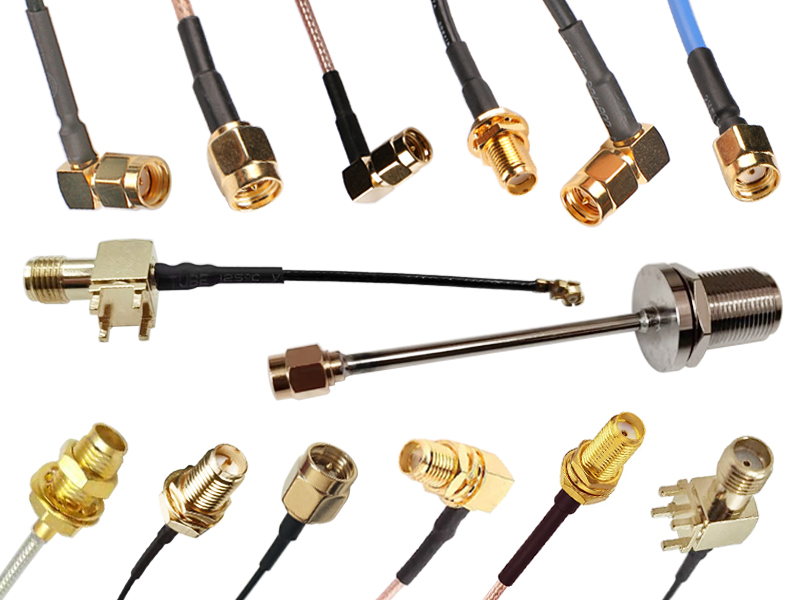
The SMA (SubMiniature version A) connector remains one of the most widely used RF interfaces in the world. With its threaded coupling, 50-ohm impedance, and excellent performance from DC to 18 GHz (and up to 26.5 GHz in precision versions), the SMA connector is a staple in telecommunications, test and measurement, aerospace, and defense. A common question for engineers and technicians is: what coaxial cables are typically terminated with SMA connectors?
The answer depends on the application—whether it is a flexible test lead, a low-loss antenna feeder, or a semi-rigid assembly for a microwave module. This article reviews the most common coaxial cable families used with SMA connectors, without reference to any specific manufacturer.
Impedance: 50 Ω Standard, 75 Ω Available
SMA connectors are predominantly designed for 50-ohm systems, the standard for RF, microwave, and wireless communications. A limited number of 75-ohm SMA variants exist for video and broadcast applications, but they are far less common. All cables discussed here are 50-ohm types unless otherwise noted.
Common Coaxial Cable Types for SMA Connectors
SMA connectors are available with crimp, solder, and clamp attachment styles to accommodate a wide range of cable diameters. The following cable families are most frequently paired with SMA connectors.
1. Flexible Cables (RG-Series and Equivalent)
Flexible cables are the most common choice for general-purpose SMA assemblies, including test leads, jumper cables, and short interconnects. They offer good flexibility at the cost of higher loss compared to semi-rigid or low-loss foam cables.
| Cable Type | Typical Applications | Key Characteristics |
| RG-58/U | General RF, test leads, amateur radio | Moderate loss, flexible, economical |
| RG-174/U | Compact, low-power, portable devices | Very thin, highly flexible, higher loss |
| RG-178/U | Ultra-compact, handheld radios, GPS | Very small diameter, flexible |
| RG-188/U | High-temperature, flexible applications | Similar to RG-178 but with PTFE dielectric |
| RG-316/U | Low-loss flexible, test and measurement | Smaller than RG-58, low loss, flexible |
| RG-400/U | High-reliability test, aerospace | Double-shielded, low loss, high temperature |
2. Low-Loss Flexible Cables (Foam-Dielectric)
Low-loss flexible cables use a foam dielectric and a braided outer conductor to achieve lower attenuation than standard RG cables while remaining flexible. They are commonly used for antenna feeders, jumper assemblies, and test leads where loss matters.
| Cable Type | Typical Applications | Key Characteristics |
| LMR-100 | Ultra-compact, short jumpers | Very thin, low loss for its size |
| LMR-195 | General-purpose RF, GPS, Wi-Fi | Flexible, low loss, similar to RG-58 but better |
| LMR-200 | Medium-length runs, in-building | Low loss, flexible, good for 2.4 GHz |
| LMR-240 | Antenna feeders, wireless infrastructure | Lower loss than LMR-200, moderate flexibility |
| LMR-400 | Long runs, base station feeders | Very low loss, excellent for cellular bands |
These cables are available in standard and low-PIM versions. For multi-carrier cellular systems, low-PIM cable is essential to prevent interference.
3. Semi-Rigid Cables
Semi-rigid cables feature a solid copper or aluminum outer conductor and a PTFE dielectric. They offer excellent shielding (>100 dB), very low loss, and superior phase stability, but they are not designed for repeated flexing. SMA connectors are commonly used with semi-rigid cables in microwave modules, test fixtures, and phase-critical systems.
| Cable Type | Typical Applications | Key Characteristics |
| UT-085 / RG-405/U | Microwave modules, test fixtures | 0.085-inch diameter, low loss, phase-stable |
| UT-047 / SR-047 | Compact microwave assemblies | 0.047-inch diameter, very low loss, tight bend radius |
| UT-141 / RG-402/U | Longer runs, lower loss | 0.141-inch diameter, used for feeders and interconnects |
SMA connectors for semi-rigid cables are typically solder-attached, ensuring a robust and repeatable interface.
4. Conformable (Formable) Cables
Conformable cables are a hybrid between semi-rigid and flexible. They have a thin-walled outer conductor that can be hand-bent and will retain its shape. They offer shielding performance close to semi-rigid while being easier to route.
| Cable Type | Typical Applications | Key Characteristics |
| 0.086-inch conformable | Aerospace, complex routing | Flexible enough to bend by hand, low loss |
| 0.141-inch conformable | Test systems, phase-critical | Lower loss, formable, good shielding |
5. Specialized Cables
SMA connectors are also used with a variety of specialized cables for specific applications:
| Cable Type | Typical Applications | Key Characteristics |
| RG-142 | Military, aerospace, high-temperature | PTFE dielectric, double-shielded, low loss |
| RG-223 | Test equipment, high-frequency | Solid dielectric, low loss, semi-flexible |
| RG-303 | Aerospace, defense | High-temperature, low loss, rugged |
| RG-393 | High-performance military | Low loss, rugged, double-shielded |
| TFT-402 | Test and measurement, plenum | Flexible, low-PIM, plenum-rated |
Summary of Common Cable Pairings
| Cable Category | Typical Size / Type | Common Applications | Key Benefits |
| RG-58, RG-174, RG-316 | Flexible, small diameter | Test leads, jumpers, portable devices | Economical, flexible, widely available |
| RG-400, RG-142 | Flexible, double-shielded | High-reliability test, aerospace | Low loss, excellent shielding |
| LMR-100, LMR-195, LMR-200 | Low-loss flexible | Antenna feeders, GPS, Wi-Fi | Lower loss than RG equivalents |
| LMR-240, LMR-400 | Low-loss flexible, larger | Base station feeders, long runs | Very low loss, high performance |
| UT-085, UT-047, UT-141 | Semi-rigid | Microwave modules, test fixtures | Excellent shielding, phase stability |
| 0.086", 0.141" conformable | Formable | Aerospace, complex routing | Hand-formable, good shielding |
| RG-223, RG-303, RG-393 | Specialized flexible/semi-rigid | Military, aerospace, high-frequency | High performance, rugged |
Selection Considerations
When choosing a coaxial cable for an SMA connector, engineers should evaluate the following factors:
| Factor | Considerations |
| Frequency range | SMA operates to 18 GHz (26.5 GHz precision). Ensure cable loss is acceptable at the highest frequency. |
| Insertion loss | Smaller cables have higher loss; larger low-loss cables are better for longer runs. |
| Flexibility | For test leads and portable equipment, flexible cables are essential. Semi-rigid is for fixed installations. |
| Phase stability | For phased arrays and coherent systems, semi-rigid or phase-stable flexible cables are required. |
| Shielding effectiveness | Semi-rigid provides >100 dB; double-shielded flexible cables provide 80–90 dB. |
| Power handling | Larger cables handle more power; SMA connectors themselves are typically rated for 1–50 W depending on frequency. |
| Environmental conditions | For outdoor use, select UV-resistant, water-blocking jackets and consider weatherproof connectors. |
| Mating cycles | SMA connectors are rated for 500 mating cycles (standard) or up to 1,000 (precision). |
Installation Best Practices
To achieve the best performance from SMA connector and cable assemblies:
Use the correct torque: SMA connectors require 0.7–0.9 Nm (6–8 in-lbs) of torque. Over-torquing damages threads; under-torquing causes high VSWR and PIM.
Use proper stripping tools: Each cable type requires specific strip lengths. Follow the connector manufacturer's instructions.
Avoid sharp bends: Exceeding the cable's minimum bend radius can damage the dielectric and degrade performance.
Keep connectors clean: Contamination is a leading cause of high VSWR and PIM. Clean mating surfaces with isopropyl alcohol before connection.
Support the cable: Avoid placing mechanical stress on the connector junction. Use cable ties and strain relief.
Test after assembly: Verify VSWR and insertion loss to ensure the assembly meets specifications.
Conclusion
The SMA connector is a versatile, high-performance interface that is compatible with a wide range of coaxial cables. It is most commonly terminated on flexible cables such as RG-58, RG-174, RG-316, and low-loss LMR types for general-purpose and test applications, and on semi-rigid cables such as UT-085 and UT-141 for microwave modules and phase-critical systems. Conformable and specialized cables round out the options for aerospace, defense, and high-reliability applications.
When selecting a cable for an SMA connector, always verify 50-ohm impedance, frequency range, power handling, flexibility, and environmental suitability. With the right cable and proper installation, an SMA connector assembly will deliver reliable, low-loss performance from DC to 18 GHz and beyond.