

-
We’re On Call 24/7 : +8613538296050
-
E-mail : anna@rohoconnector.com
We’re On Call 24/7 : +8613538296050
E-mail : anna@rohoconnector.com
As global demand for data skyrockets and 5G networks expand into higher frequencies, the infrastructure supporting them faces unprecedented power and reliability challenges. At the heart of this challenge lies a critical, yet often overlooked, component: the RF terminator. Among the various types, those featuring the robust 7/16 DIN interface are emerging as the cornerstone for high-power, high-reliability applications in cellular infrastructure and demanding industrial settings.
Unlike their smaller SMA or N-type counterparts, 7/16 DIN terminators are engineered from the ground up for power and resilience. The connector's name reveals its key advantage: a 7mm inner contact and a 16mm outer diameter, providing a significantly larger cross-sectional area for handling high currents and dissipating heat compared to common alternatives. This inherent ruggedness makes them the preferred choice for terminating ports on high-power amplifiers, combiners, and tower-mounted equipment where failure is not an option.
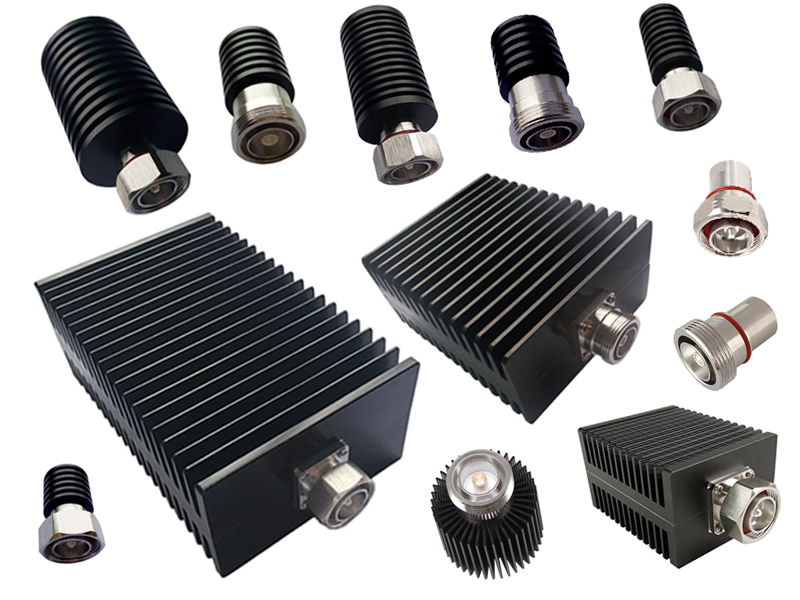
Understanding the landscape of 7/16 DIN terminators requires looking at three key classification criteria, each tailoring the component to specific operational needs.
By Power Rating and Application:
Medium-Power Terminators (Up to 50W): These are the workhorses for most standard cellular base station equipment, including feed lines and antenna ports. They are designed for continuous wave (CW) operation in demanding environmental conditions, often featuring ruggedized construction.
High-Power Loads (100W and above): Engineered for the most strenuous applications, such as terminating high-power broadcast transmitters or the final stages of macro-cell power amplifiers. Models like ROHO's terminators are rated for 100W average power and are built with advanced thermal management systems, such as black anodized aluminum housings, to dissipate immense heat.
By Connector Gender and Configuration:
Standard Single-Ended Terminators: These come in male (plug) or female (jack) configurations to directly match the port they are terminating. The female variant is particularly common for panel-mount applications on equipment.
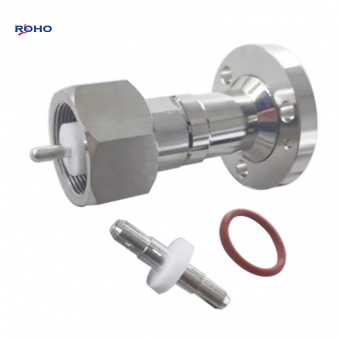
In-Line or "Bullet" Terminators: Featuring a connector on both ends (e.g., female-to-female), these are designed to be inserted directly into a transmission line, providing termination at a specific point in the RF path rather than at an equipment port.
By Frequency of Operation:
While 7/16 DIN connectors can theoretically operate up to 7.5 GHz or higher, terminators are typically optimized for specific bands crucial to telecommunications:
Sub-3 GHz Models: Optimized for core cellular bands (600 MHz to 2.7 GHz), which form the backbone of 4G LTE and much of 5G coverage.
Extended Range Models: Designed to support broader spectra up to 6 GHz, future-proofing systems for 5G expansion and advanced wireless services.
The value proposition of a 7/16 DIN terminator is defined by a suite of performance characteristics that ensure system integrity under stress.
Exceptional Power Handling and Thermal Management: The primary advantage is the ability to safely absorb and dissipate high average power. This is achieved through large, thermally conductive metal bodies and, in high-power models, integrated heat-sinking designs. Performance is often specified with a derating curve relative to ambient temperature.
Superior Low-PIM Performance: Passive Intermodulation (PIM) is a critical distortion phenomenon in multi-carrier cellular systems. The robust, high-quality metal-to-metal contact in 7/16 DIN interfaces inherently provides excellent low-PIM performance, which is why they are the standard for FDD-LTE systems where transmit and receive signals coexist. This makes 7/16 DIN terminators essential for maintaining signal clarity and network capacity.
Low Voltage Standing Wave Ratio (VSWR): A quality terminator must present a near-perfect impedance match (typically 50Ω) to the system. Leading 7/16 DIN terminators achieve remarkably low VSWR values, such as 1.25:1 or better across their operational band, ensuring minimal signal is reflected back to cause interference or damage.
Ruggedized and Weatherproof Construction: Designed for outdoor use, these components feature robust metal housings (often brass or stainless steel) with corrosion-resistant plating. Many are rated for IP67 environmental sealing when mated, protecting against dust and moisture ingress to ensure reliable operation from -55°C to +125°C in extreme weather conditions.
Mechanical Durability: Built to withstand the rigors of tower installation and long-term environmental exposure, 7/16 DIN connectors are specified for a mechanical life of 500 mating cycles or more, far exceeding the needs of most semi-permanent installations.
The shift towards dense urban small cells and higher-order MIMO configurations in 5G may favor smaller connectors in some new deployments. However, the massive installed base of macro-cell infrastructure and the relentless need for high-power handling in broadcast, radar, and industrial applications ensure that the 7/16 DIN terminator will remain a vital component for decades to come. Its unmatched blend of power, low-PIM performance, and environmental ruggedness secures its role as the guardian of signal integrity at the network's highest-power edges.