

-
We’re On Call 24/7 : +8613538296050
-
E-mail : anna@rohoconnector.com
We’re On Call 24/7 : +8613538296050
E-mail : anna@rohoconnector.com
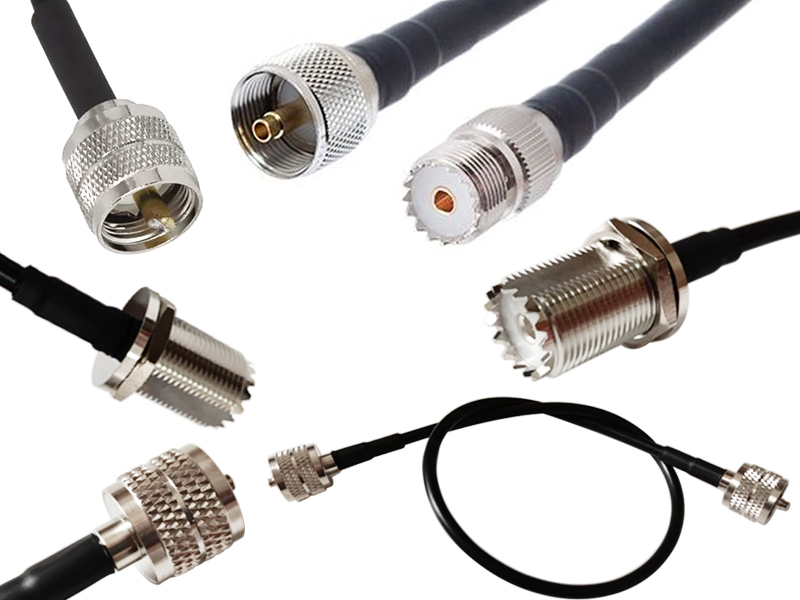
The UHF connector—known to most practitioners as the PL-259 (male) and SO-239 (female)—is one of the oldest and most recognizable RF interfaces still in everyday use. Despite the name, it is not a true UHF connector in the modern sense. It performs best below 300 MHz and becomes increasingly lossy and reflective as frequency rises. Yet its rugged threaded coupling, low cost, and ease of field installation keep it popular in amateur radio, legacy communications, marine radio, and low-frequency video systems.
One of the most common questions about UHF connectors is simple: what coaxial cables are normally used with them? The answer depends on whether the system is 50 ohms or 75 ohms, how much power is involved, and how long the cable run must be.
A Quick Note on Impedance
UHF connectors do not have a constant characteristic impedance. They are usually treated as 50-ohm connectors, but they can also be found on 75-ohm cables in video and CCTV work. For best performance, match the cable impedance to the system impedance. A 50-ohm UHF connector on a 75-ohm cable will introduce mismatch, raising VSWR and adding reflections. At low frequencies and short distances this may be tolerable, but it is not ideal for clean RF transmission.
Common Coaxial Cables Used with UHF Connectors
50-Ohm Cables
These are the most common pairings for RF, amateur radio, and two-way radio applications.
| Cable Type | Typical Use | Key Characteristics |
| RG-58/U | Short jumpers, test leads, low-power radio | Flexible, small diameter, moderate loss |
| RG-8X | Compact HF/VHF installations | Smaller than RG-8, lower loss than RG-58 |
| RG-8/U | HF/VHF base stations, moderate power | Large diameter, low loss, rugged |
| RG-213/U | High-power HF/VHF, long runs | Low loss, high power handling, robust |
| RG-214/U | High-power, interference-prone sites | Double-shielded version of RG-213 |
| RG-400/U | High-reliability test and aerospace | Double-shielded, low loss, high temperature |
| Low-loss 400-series | Base station feeders, long runs | Very low loss, moderate flexibility |
RG-58 is the classic “starter” cable for UHF connectors: easy to solder, easy to route, and adequate for short runs. RG-8 and RG-213 are preferred when power is higher or the cable run is longer. RG-214 adds extra shielding for noisy environments. Low-loss 400-series cable is a modern alternative for operators who need lower attenuation without moving to hardline.
75-Ohm Cables
UHF connectors also appear on 75-ohm cables, especially in older video, CCTV, and broadcast installations.
| Cable Type | Typical Use | Key Characteristics |
| RG-11/U | Long video runs, CCTV | Large diameter, low loss at video frequencies |
| RG-59/U | Short video runs, CCTV, legacy TV | Flexible, small diameter, moderate loss |
These pairings are generally limited to low-frequency video and should not be confused with precision 75-ohm RF systems. If impedance matching matters, use the correct 75-ohm connector family rather than a UHF connector.
How to Choose the Right Cable
When selecting a coaxial cable for a UHF connector, consider the following:
Frequency: Below 30 MHz, almost any 50-ohm cable will work. Above 100 MHz, loss rises quickly, so choose lower-loss cable.
Power: Higher transmit power requires larger conductors and better heat dissipation. RG-213 and RG-8 handle far more power than RG-58.
Run length: Short jumpers can use small flexible cable. Long runs need low-loss cable to avoid excessive attenuation.
Flexibility: RG-58 and RG-8X are easy to route. RG-8, RG-213, and low-loss 400-series cable are stiffer.
Shielding: In electrically noisy environments, double-shielded cables such as RG-214 or RG-400 are preferable.
Environment: Outdoor installations need UV-resistant jackets and proper weather sealing at the connector.
Connector attachment: UHF connectors are commonly solder-type or clamp-type. Some crimp-style versions exist, but solder and clamp remain the most field-serviceable.
Installation Tips
UHF connectors are forgiving, but poor installation still causes problems.
Prepare the cable correctly: Strip the jacket, shield, and dielectric to the dimensions specified for the connector.
Avoid overheating: When soldering the center pin, use a hot iron and work quickly. Excessive heat can melt the dielectric and shift the center conductor.
Secure the shield: For clamp-style connectors, ensure the braid is evenly distributed and firmly clamped.
Weatherproof outdoor connections: Use self-amalgamating tape and a sealing compound to keep moisture out.
Provide strain relief: Support the cable so the connector does not carry mechanical load.
Check continuity and shorts: Before applying power, verify that the center conductor and shield are not shorted and that continuity is good end to end.
Summary of Common Pairings
| Application | Recommended Cable | Impedance |
| Short test lead, low power | RG-58/U | 50 Ω |
| Compact HF/VHF station | RG-8X | 50 Ω |
| HF/VHF base station, moderate power | RG-8/U | 50 Ω |
| High-power HF/VHF, long run | RG-213/U | 50 Ω |
| Noisy RF environment | RG-214/U | 50 Ω |
| High-reliability test/aerospace | RG-400/U | 50 Ω |
| Long low-loss feeder | Low-loss 400-series | 50 Ω |
| Legacy video/CCTV, long run | RG-11/U | 75 Ω |
| Legacy video/CCTV, short run | RG-59/U | 75 Ω |
Final Thoughts
The UHF connector may be old, non-constant impedance, and unsuited to true UHF work, but it remains a practical and widely used interface for low-frequency RF. Its most common cable partners are RG-58, RG-8X, RG-8, RG-213, and RG-214 in 50-ohm systems, with RG-11 and RG-59 appearing in 75-ohm video and CCTV installations. Choose the cable according to frequency, power, run length, and environment—and remember that a good connector on the wrong cable will still deliver disappointing results. Match the cable to the job, install it carefully, and the trusty PL-259/SO-239 pair will keep working for years.
Tags :