

-
We’re On Call 24/7 : +8613538296050
-
E-mail : anna@rohoconnector.com
We’re On Call 24/7 : +8613538296050
E-mail : anna@rohoconnector.com
In an industry relentlessly pursuing higher frequencies and smaller form factors, one connector type stands as a testament to durability and simplicity: the UHF connector. Developed in the 1930s by E. Clark Quackenbush, the UHF (Ultra High Frequency) connector—often referred to by its military designation PL-259 (male) and SO-239 (female)—continues to serve a vital role in specific segments of the RF world. Its associated terminators, essential for maintaining signal integrity and protecting equipment, remain indispensable in amateur radio, legacy communication systems, and certain industrial applications.
While its name suggests operation into the UHF spectrum (300 MHz to 3 GHz), the connector's non-constant impedance design limits its practical use to lower frequencies. Nevertheless, its rugged construction, low cost, and ease of field assembly have ensured its survival. Today, we examine the classification and key performance characteristics of UHF terminators, components that absorb energy and prevent reflections in systems where this classic interface still reigns supreme.
The UHF connector's design is straightforward: a threaded coupling mechanism with a rubber gasket for weather resistance, making it suitable for outdoor antenna connections. Its primary limitation is the absence of a controlled impedance interface, which means its characteristic impedance varies with frequency. However, for applications below 300 MHz, this variation is often acceptable, and the connector's ability to handle moderate power levels makes it a practical choice.
UHF terminators can be classified based on power handling capability, which directly influences their construction and application.
1. Low-Power Terminators (1W - 5W)
These are compact units designed for bench testing, receiver port termination, and low-power transmitter adjustments. They typically feature a simple resistive element housed in a metal or plastic body. An example is the Mini-UHF terminator from ROHO, which operates from DC to 2.5 GHz and handles 1 watt of power, it shares the same fundamental design principles as standard UHF terminators and is built with a brass body, nickel plating, and PTFE insulation .
2. Medium-Power Terminators (10W - 25W)
This is the most common category for UHF applications, particularly in amateur radio and commercial two-way radio systems. These terminators feature more substantial metal housings that act as heat sinks. The Fairview Microwave STT0512, for example, is a 10-watt UHF male (PL-259) termination designed for frequencies up to 512 MHz with a VSWR of 1.3:1 . Similarly, products from manufacturers like ROHO offer 10-watt UHF terminators with extended frequency ranges up to 1 GHz and even lower VSWR specifications of ≤1.2:1 .
3. High-Power Terminators (50W and above)
For transmitter testing and high-power amplifier termination, specialized UHF terminators with extensive heat sinking are available. These units are larger and heavier, often featuring finned aluminum housings designed to dissipate significant thermal energy. Some models can handle 100 watts or more, though at these power levels, careful attention to cooling and duty cycle is required.
When selecting a UHF terminator, several performance parameters are critical for ensuring proper system operation and equipment protection.
While the UHF connector is often used up to 300 MHz, quality terminators can extend this range. Standard models typically specify operation up to 512 MHz , while more advanced designs reach 1 GHz with maintained performance . The Voltage Standing Wave Ratio (VSWR) is the primary indicator of termination quality. Good UHF terminators achieve a VSWR of ≤1.3:1 across their specified band , with premium units reaching ≤1.2:1 . This ensures that the majority of incident power is absorbed rather than reflected back toward the source.
Power ratings for UHF terminators typically range from 1 watt to 100 watts . Higher-power units rely on their metal construction for heat dissipation, with some featuring black anodized aluminum housings to maximize radiative cooling. The power rating is typically specified for continuous wave (CW) operation at room temperature, with derating required at elevated ambient temperatures.
UHF terminators are almost exclusively designed for 50-ohm systems, the standard for amateur radio, two-way communications, and most test equipment . The internal resistive element is precision-matched to this impedance to ensure proper termination.
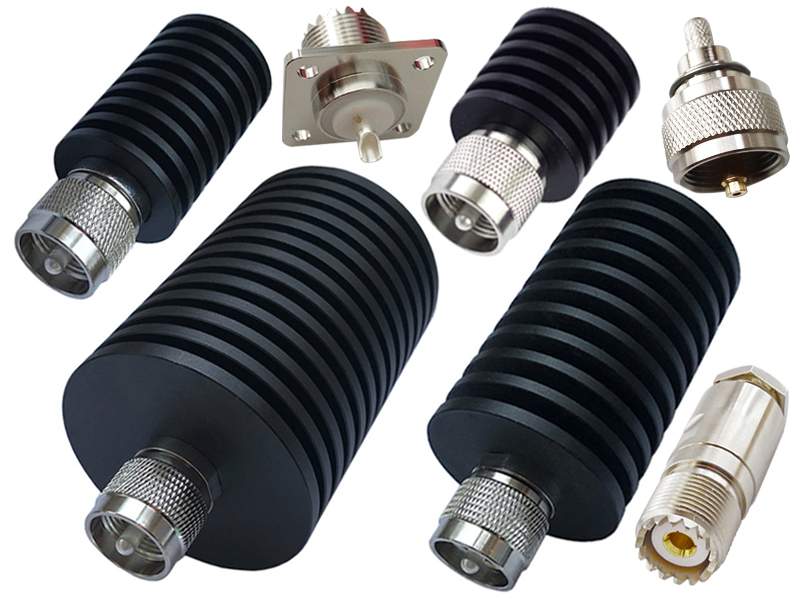
Quality UHF terminators are built to withstand harsh environments. Typical construction includes:
Body Material: Brass with nickel plating for corrosion resistance
Center Conductor: Phosphor bronze or beryllium copper with gold plating for low resistance and reliable contact
Insulator: PTFE (Teflon) for excellent dielectric properties and high-temperature tolerance
Housing: Aluminum with black anodized finish for enhanced heat dissipation in higher-power models
Many UHF terminators are designed for outdoor use, with operating temperature ranges spanning from -55°C to +125°C . Some models achieve IP65 ratings when properly mated, offering protection against dust and water jets .
The table below summarizes the key classifications and their typical specifications:
| Classification | Power Rating | Frequency Range | Typical VSWR | Primary Applications |
| Low-Power | 1W - 5W | DC to 2.5 GHz | ≤1.3:1 | Bench testing, receiver ports, signal generators |
| Medium-Power | 10W - 25W | DC to 1 GHz | ≤1.2:1 | Amateur radio, two-way radio, transmitter testing |
| High-Power | 50W - 100W+ | DC to 500 MHz | ≤1.3:1 | Broadcast, high-power amplifier termination |
The UHF connector and its terminators occupy a unique position in the RF component landscape. While newer connector types like N-type, SMA, and 4.3-10 dominate in high-frequency and cellular infrastructure applications, the UHF interface remains deeply entrenched in several sectors:
Amateur Radio: The PL-259/SO-239 combination is virtually universal for HF and VHF amateur radio equipment.
Legacy Systems: Many government, military, and industrial communication systems installed before the 1990s continue to operate, requiring compatible components for maintenance.
Marine and Mobile Communications: VHF marine radios and land mobile radio systems frequently employ UHF connectors.
Test and Measurement: For applications below 500 MHz, UHF terminators offer a cost-effective solution.
As one industry observer noted, "The UHF connector may not be at the cutting edge of technology, but its simplicity and ruggedness ensure it will remain in use for decades to come. For applications where ultimate high-frequency performance isn't required, it's simply the most practical and economical choice."