

-
We’re On Call 24/7 : +8613538296050
-
E-mail : anna@rohoconnector.com
We’re On Call 24/7 : +8613538296050
E-mail : anna@rohoconnector.com
In the ever-advancing world of high-frequency electronics, the ability to accurately terminate a transmission line is just as critical as generating a clean signal. As systems push into the millimeter-wave spectrum—5G, satellite communications, automotive radar, and test instrumentation—the demands on coaxial components intensify. Enter the 2.92mm terminator, a precision device designed to deliver exceptional performance from DC to 40 GHz and beyond. With its robust construction, excellent repeatability, and compatibility with other popular interfaces, the 2.92mm terminator has become a staple in laboratories, production test environments, and high-frequency subsystems.
This blog post explores the classification and key performance characteristics of 2.92mm terminators, providing engineers with the knowledge to select the right component for their millimeter-wave applications.
The 2.92mm connector (also known as the K connector ) was developed in the 1980s by Wiltron (now Anritsu) as a rugged, high-performance interface capable of operating up to 40 GHz. It features an air dielectric interface and a threaded coupling mechanism, ensuring excellent mechanical stability and repeatability. The outer diameter of the outer conductor is 2.92 mm, giving the connector its name.
One of the key advantages of the 2.92mm interface is its compatibility with other common precision connectors:
SMA connectors (operating up to 18 GHz) can be mated with 2.92mm, though care must be taken because the pin depth and dielectric interface differ.
3.5mm connectors (up to 34 GHz) are fully compatible with 2.92mm, as both adhere to the same air-line interface dimensions.
2.4mm and 1.85mm connectors are not directly compatible, though adapters exist.
Because of this compatibility, 2.92mm terminators are often used to terminate SMA or 3.5mm ports in high-frequency test setups without sacrificing performance.
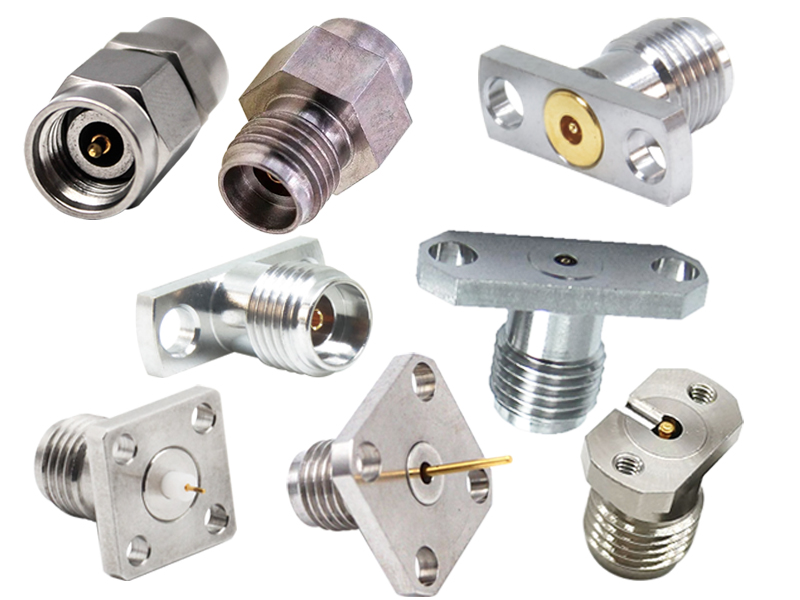
2.92mm terminators can be classified along several axes: power handling, mechanical configuration, and precision grade. Understanding these categories helps match the terminator to the specific application.
Power handling is a primary differentiator. Because 2.92mm components are optimized for low-loss transmission at high frequencies, their power ratings are generally modest compared to larger connectors like N-type. However, they can still accommodate a wide range of power levels.
| Power Class | Typical Average Power | Applications |
| Low-Power | 0.5 W – 2 W | Signal-level terminations, receiver ports, low-power test equipment |
| Medium-Power | 2 W – 10 W | General-purpose RF testing, benchtop instruments, some transmitter stages |
| High-Power | 10 W – 50 W | Specialized high-power amplifier terminations, pulsed applications |
Most standard 2.92mm terminators are rated for 2 W average power. High-power variants incorporate larger thermal masses and sometimes finned heatsinks to dissipate heat, allowing ratings up to 50 W at lower frequencies.
Male (Plug) Terminators: Feature a center pin and a threaded coupling nut. Used to terminate female connectors on cables or equipment.
Female (Jack) Terminators: Feature a center socket and a threaded body. Used to terminate male connectors.
Chain or Bulkhead Mount: Some terminators include a chain or are designed for bulkhead mounting to prevent loss or provide a permanent test point.
Right-Angle Terminators: Occasionally available for space-constrained applications where a straight terminator would be impractical.
Standard / Commercial Grade: Designed for general lab and production use. They offer good VSWR (typically ≤ 1.20:1 up to 40 GHz) and are cost-effective.
Precision / Metrology Grade: These terminators are individually tested and calibrated, often supplied with traceable VSWR or return loss data. They achieve extremely low VSWR (e.g., ≤ 1.10:1 up to 40 GHz) and are used in calibration kits and measurement standards.
Virtually all 2.92mm terminators are 50 Ω, in line with the standard for high-frequency RF and microwave systems. 75 Ω versions are extremely rare and generally not part of the standard product portfolio.
When evaluating a 2.92mm terminator, several performance parameters are critical to ensuring signal integrity and measurement accuracy.
The defining characteristic of the 2.92mm interface is its ability to operate to 40 GHz with excellent performance. Some high-quality models are rated up to 46 GHz or even 50 GHz, though the connector's design limit is typically 40 GHz for guaranteed specifications. The usable frequency range is from DC to the stated maximum, making these terminators suitable for applications covering baseband through millimeter-wave.
VSWR is the most important metric for a terminator. It measures how well the device matches the 50 Ω impedance. A perfect match would have a VSWR of 1.00:1. In practice, quality 2.92mm terminators achieve:
Standard Grade: VSWR ≤ 1.20:1 (or ≤ 1.25:1) from DC to 40 GHz.
Precision / Calibration Grade: VSWR ≤ 1.10:1 or even ≤ 1.08:1 across the full frequency range.
Low VSWR ensures minimal signal reflection, which is essential for accurate network analyzer calibrations, precise power measurements, and preventing damage to sensitive sources.
The average power rating is usually specified for continuous wave (CW) operation at room temperature. A typical 2.92mm terminator handles 2 W average power. Derating curves apply at elevated ambient temperatures. Peak power ratings for pulsed applications can be significantly higher (e.g., 100 W peak) for short pulses.
For applications requiring more than a few watts, users should select high-power models (≥ 10 W) and pay close attention to thermal management, ensuring adequate airflow or heatsinking.
Return loss is the logarithmic expression of VSWR and is often used interchangeably. For a VSWR of 1.20:1, the return loss is approximately 20.8 dB. For a VSWR of 1.10:1, return loss improves to about 26.4 dB. High return loss directly translates to better measurement accuracy and system performance.
The materials used in a 2.92mm terminator directly affect its durability, temperature stability, and electrical performance.
Body: Typically stainless steel, either passivated or plated, for excellent mechanical strength and corrosion resistance. Some low-cost versions may use brass with nickel plating.
Center Contact: Beryllium copper (BeCu) or phosphor bronze with gold plating over a nickel underplating. Gold ensures low contact resistance and high corrosion resistance.
Dielectric: PTFE (polytetrafluoroethylene) or, in air-line sections, no dielectric. PTFE offers low loss and stable dielectric constant over temperature.
Coupling Nut: Stainless steel with a smooth finish for reliable mating.
2.92mm terminators are designed for laboratory and field use. Typical environmental specifications include:
Operating Temperature: -55 °C to +125 °C (sometimes +85 °C for commercial grades).
Storage Temperature: -55 °C to +125 °C.
Durability: Rated for ≥ 500 mating cycles (precision grades may have lower cycle life to maintain electrical performance).
Sealing: Most are not hermetically sealed but offer adequate protection for indoor use. For outdoor or harsh environments, specialized sealed versions may be required.
For applications such as multi-carrier cellular systems, PIM can be a critical concern. While 2.92mm connectors are not the primary choice for low-PIM applications (that domain belongs to 4.3-10 or N-type), some 2.92mm terminators are specifically designed with low-PIM materials and construction. These are often used in test setups for high-frequency, multi-signal environments.
For applications requiring precise phase relationships, such as phased array antenna testing, the phase stability of a terminator under temperature and mechanical stress may be relevant. Precision terminators often specify phase stability versus temperature, with values typically expressed in degrees per °C.
When choosing a 2.92mm terminator, consider the following:
| Selection Factor | Considerations |
| Frequency | Ensure the terminator’s specified frequency range covers your highest operating frequency, including harmonics if testing nonlinear devices. |
| Power | Calculate average and peak power; choose a terminator with adequate headroom. Remember to derate for high temperatures. |
| VSWR / Return Loss | For calibration and precision measurements, select a precision grade with VSWR ≤ 1.10:1. For general lab use, standard grade (≤ 1.20:1) is usually sufficient. |
| Connector Gender | Match the gender to the port: male terminator for female port, female terminator for male port. |
| Durability | For frequent connection/disconnection, choose a terminator with high mating cycle rating and robust materials. |
| Application Environment | For benchtop use, standard stainless steel is fine. For field or industrial use, verify temperature range and any sealing requirements. |
| Calibration | If the terminator will be used as a calibration standard, ensure it is supplied with individual test data (VSWR, return loss) traceable to a national standards lab. |
Vector Network Analyzer (VNA) Calibration: 2.92mm terminators are essential components of calibration kits for VNAs operating up to 40 GHz. Precision terminations with low VSWR provide the reference load for SOLT (Short-Open-Load-Through) calibration.
High-Frequency Component Testing: When testing amplifiers, filters, or antennas, unused ports must be properly terminated to prevent reflections that could distort measurements. 2.92mm terminators are ideal for this purpose in the 0–40 GHz range.
5G mmWave Test Systems: With 5G frequencies extending to 28 GHz, 39 GHz, and beyond, 2.92mm connectors are a popular choice for test interfaces in both conducted and over-the-air (OTA) test setups.
Aerospace and Defense: Radar, electronic warfare, and satellite communication systems operating in K- and Ka-bands rely on 2.92mm terminators for system integration and test.