

-
We’re On Call 24/7 : +8613538296050
-
E-mail : anna@rohoconnector.com
We’re On Call 24/7 : +8613538296050
E-mail : anna@rohoconnector.com
In the world of electronics, from bustling research labs to complex broadcast trucks, there is a simple, ubiquitous device that stands as a silent guardian of signal integrity: the BNC terminator. Often overlooked, this component plays a critical role in ensuring accurate measurements, protecting sensitive equipment, and stabilizing systems. As systems evolve towards higher frequencies, the classic BNC terminator remains a relevant and vital tool, continuously refined for modern demands.
A BNC terminator is a passive device that provides a matched impedance load at the end of a coaxial transmission line. Its core function is to absorb transmitted RF energy, preventing it from reflecting back into the system. These reflections, if unchecked, cause signal distortions known as standing waves, which can lead to measurement errors, degraded performance, and even damage to amplifiers or oscillators.
BNC terminators can be categorized in several ways, helping engineers select the perfect component for their specific application.
1. By Power Handling Capability
This is the primary classification, dictating the terminator's size, construction, and cooling.
Low-Power (0.5W - 1W): These are the most common, compact terminators used on benchtop test equipment like oscilloscopes, signal generators, and logic analyzers. They are essential for preventing ringing on digital lines and ensuring clean signal edges in high-speed digital applications. Models like the Telegartner BNC terminator are standard in labs worldwide.
Medium-Power (1W - 5W): Built with more robust housings and better thermal dissipation, these handle the output of low-power RF sources, general-purpose radio equipment, and are used in video distribution networks.
High-Power (5W and above): These feature large, finned metal bodies designed as heatsinks. They are used in specialized applications such as terminating higher-power communication lines or in specific test setups for transmitters.
2. By Impedance
The impedance must match the characteristic impedance of the system.
50-Ohm: The overwhelming standard for RF and high-frequency measurement systems. Nearly all general-purpose and RF lab equipment uses 50-ohm BNC terminators.
75-Ohm: Standard for video systems (broadcast, CCTV), cable television (CATV) infrastructure, and some older data communication standards. Using a 75-ohm terminator on a 50-ohm line (or vice versa) will cause a significant impedance mismatch and poor performance.
3. By Connector Configuration
Standard Terminators: Feature a single BNC connector (male or female) on one end.
"T" or In-Line Terminators: These have two BNC connectors (e.g., female-to-female) allowing them to be inserted into the middle of a cable run to terminate a branch line or a specific node in a circuit without disconnecting the main line.
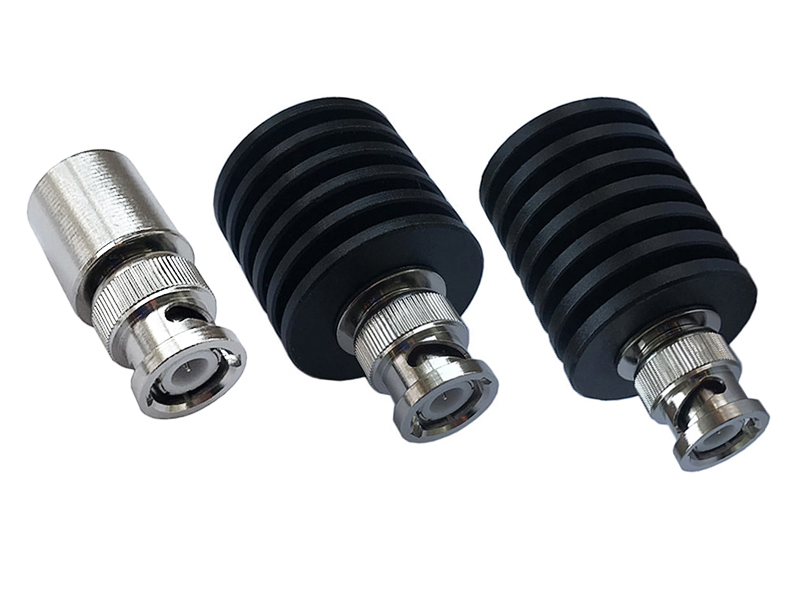
The following table summarizes the common classifications and their typical applications:
| Classification | Power Rating | Impedance | Primary Application |
| Standard Bench | 0.5W - 1W | 50 Ω | Test & Measurement (Oscilloscopes, Analyzers) |
| Video/Broadcast | 1W - 2W | 75 Ω | CCTV, Broadcast Video, CATV Systems |
| General RF | 1W - 5W | 50 Ω | Low-power RF Sources, Lab Equipment Ports |
| High-Power RF | 5W+ | 50 Ω | Transmitter Test, Specialized Communication Lines |
When selecting a BNC terminator, several specifications are crucial for ensuring it performs its job effectively.
1. Frequency Range and VSWR
The BNC connector is traditionally considered usable up to about 4 GHz. However, performance is highly dependent on the internal construction of the terminator.
General-Purpose: Effective from DC to 1-2 GHz.
High-Frequency/RF Grade: Precision models are optimized for performance up to 3 GHz or even 6 GHz. The key metric here is Voltage Standing Wave Ratio (VSWR), which measures how well the terminator matches the line impedance. A perfect match is 1.0:1. High-quality RF terminators maintain a VSWR below 1.3:1 (or even 1.1:1) across their specified range, ensuring minimal reflection.
2. Power Rating and Thermal Design
The average power rating (in watts) indicates how much continuous power the terminator can dissipate as heat without damage. Exceeding this rating is a common failure mode. Higher-power units use metal casings with fins to increase surface area and promote cooling.
3. DC Resistance and Connector Quality
Internally, a terminator is a precision resistor. Its DC resistance should equal its rated impedance (e.g., 50.0 ohms ±1%). The quality of the BNC connector itself—with gold-plated contacts and a secure bayonet coupling—ensures a reliable, low-resistance connection that won't degrade over many mating cycles.
4. Durability and Temperature Stability
For robust applications, terminators are built with full-metal bodies. Their performance should remain stable across an operating temperature range (e.g., -55°C to +125°C for military-grade components), meaning the impedance and VSWR change very little with temperature fluctuations.