

-
We’re On Call 24/7 : +8613538296050
-
E-mail : anna@rohoconnector.com
We’re On Call 24/7 : +8613538296050
E-mail : anna@rohoconnector.com
In the relentless pursuit of more powerful and compact wireless infrastructure, a key component is undergoing a quiet revolution: the RF terminator. As network operators squeeze more antennas and radios into ever-smaller spaces to support 5G and beyond, the bulky connectors of the past are giving way to more efficient designs. Leading this charge is the 4.3-10 terminator, a component rapidly becoming the new standard for modern, high-density base stations and distributed antenna systems (DAS).
Unlike its larger predecessors, the 4.3-10 interface was specifically engineered to meet the dual demands of miniaturization and superior electrical performance. Its name denotes its compact dimensions, and it represents a significant leap forward, offering a future-proof solution for the networks that connect our world.
4.3-10 terminators can be effectively categorized by their power handling capability, which directly dictates their design and primary use case. The table below outlines the common classifications found in the market:
| Classification | Typical Power Rating | Key Characteristics & Applications |
| General-Purpose / Medium-Power | 10W - 25W | Common for indoor/outdoor use on DAS and small cell equipment. Often feature IP65/67 ratings for environmental protection. |
| High-Power | 50W - 100W | Designed for robust, continuous operation in demanding macro base station applications. Feature enhanced thermal management. |
| Ultra-Low PIM Focused | Varies (e.g., 10W, 25W) | Optimized for critical multi-carrier, multi-operator environments. Key for preventing interference in modern FDD-LTE and 5G systems. |
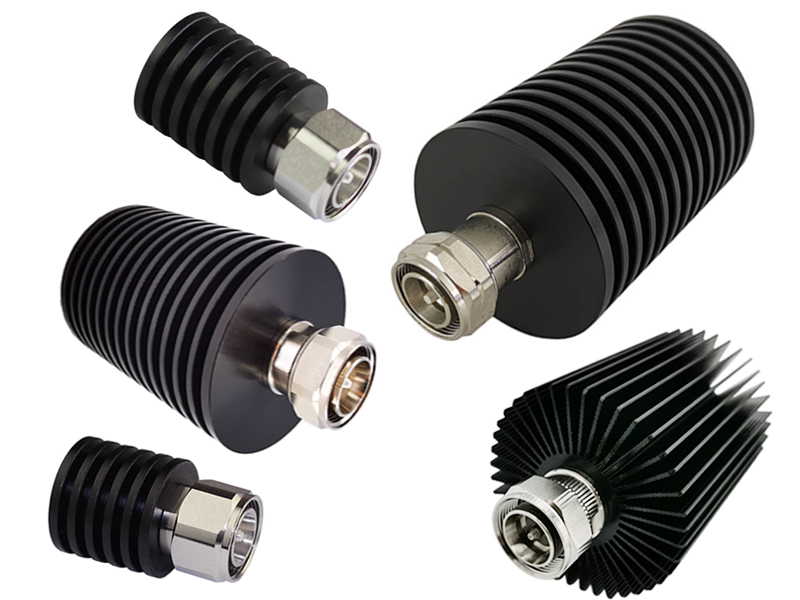
The shift to 4.3-10 is not merely about size. It brings a suite of performance enhancements critical for today's complex RF ecosystems.
Superior Frequency and VSWR Performance: The 4.3-10 standard is designed for an upper operating frequency limit of 6 GHz, comfortably covering current and near-future cellular bands. To ensure efficient signal transfer within this range, high-quality terminators achieve an exceptionally low Voltage Standing Wave Ratio (VSWR), typically 1.25:1 or better across the entire band, minimizing harmful signal reflections.
Exceptional Low-PIM Design: This is arguably the most critical advancement. Passive Intermodulation (PIM) is a form of distortion that can severely degrade network capacity and quality. The 4.3-10 connector's mechanical design prioritizes low PIM, with many terminators boasting performance of -160 dBc or better under high power. This makes them indispensable for crowded urban cell sites.
Ruggedized for Real-World Deployment: These components are built to last. Constructed with robust metal housings, they are engineered to withstand harsh environmental conditions. Many models carry an IP65 or IP67 ingress protection rating, ensuring reliable operation in rain, dust, and extreme temperatures ranging from -30°C to +85°C or beyond.
The Standardized Advantage: The 4.3-10 interface is governed by the international standard IEC 61169-54, which ensures interoperability, consistent performance, and reliability across manufacturers. This standardization gives network engineers confidence in their infrastructure choices.
The transition to 4.3-10 terminators reflects the broader evolution of wireless networks: smaller, denser, and smarter. For anyone specifying components for new macro sites, DAS deployments, or small cell grids, the choice is increasingly clear.
When selecting a 4.3-10 terminator, prioritize the specifications that match your site's profile: ensure the power rating has ample headroom, verify the low PIM performance for multi-carrier sites, and always choose components with the appropriate environmental sealing for their installation location.
Tags :