

-
We’re On Call 24/7 : +8613538296050
-
E-mail : anna@rohoconnector.com
We’re On Call 24/7 : +8613538296050
E-mail : anna@rohoconnector.com
The 7/16 DIN connector stands as one of the most robust and high-performance interfaces in the RF world. Developed decades ago for demanding telecommunications applications, this connector features a large, threaded coupling mechanism that provides exceptional mechanical strength, low passive intermodulation (PIM), and reliable performance up to 6 GHz (with precision variants reaching 7.5 GHz). Its 7 mm inner conductor and 16 mm outer conductor dimensions give it its name and enable superior power handling compared to smaller connectors like N-Type or SMA.
One of the key strengths of the 7/16 DIN interface is its compatibility with a range of high-performance coaxial cables designed for low loss, high power, and long-distance transmission. This article provides an overview of the coaxial cable families that commonly terminate with 7/16 DIN connectors, as well as guidance on selecting the right cable for your application.
The Importance of Cable Selection
The 7/16 DIN connector is typically used in high-power and outdoor infrastructure applications—macro-cell base stations, broadcast transmitters, distributed antenna systems (DAS), and radar systems. The cables chosen for these applications must match the connector's capabilities: low attenuation at cellular frequencies, high power handling, weather resistance, and long-term reliability.
Unlike smaller connectors (e.g., SMA, SMB), which often terminate thin, flexible cables, 7/16 DIN connectors are most commonly used with medium to large diameter coaxial cables that offer low loss and high power capacity. The following cable families are the most frequently paired with 7/16 DIN connectors.
Classification of Compatible Cables
1. LMR-Series Cables (Low-Loss, High-Performance)
The LMR (Low-Loss, Multi-purpose, Reliable) series is one of the most popular cable families for wireless infrastructure. These cables offer excellent performance with lower attenuation and better shielding than traditional RG cables. Common LMR cables compatible with 7/16 DIN connectors include:
| Cable Type | Typical Applications | Key Characteristics |
| LMR-400 | Base station feeder cables, short to medium jumper runs, DAS | Low loss, flexible, excellent for 2-way radio and cellular bands |
| LMR-500 | Medium-length runs, distributed antenna systems | Lower loss than LMR-400, moderate flexibility |
| LMR-600 | Long cable runs, tower feeds, high-power applications | Very low loss, ideal for long-distance transmission |
| LMR-900 | High-power, long-distance base station feeder cables | Ultra-low loss, larger diameter, superior performance |
| LMR-1200 | Extended long-distance, high-power broadcast applications | Extremely low loss, large diameter |
| LMR-1700 | Very long-distance transmission, high-power systems | The lowest loss in the LMR series, large and rigid |
Note: LMR cables above LMR-600 are significantly larger and less flexible, requiring careful installation routing and support.
2. RG-Series Cables (Military Designation)
Several larger-diameter RG-series cables are commonly terminated with 7/16 DIN connectors for high-power and low-loss applications.
| Cable Type | Typical Applications | Key Characteristics |
| RG-8 / RG-8A/U | Amateur radio, base stations, broadcast | Large diameter, low loss, rugged, time-tested |
| RG-213 / RG-213/U | High-power amateur radio, base station feeds | Low-loss, robust, excellent for high-power transmission |
| RG-214 / RG-214/U | High-power, double-shielded applications | Similar to RG-213 with extra shielding for interference-prone environments |
| RG-217 | Very high-power, low-frequency applications | Large diameter, extremely low loss |
| RG-218 | Broadcast, high-power radar | Very large, very low loss, rigid |
| RG-393 | Military and aerospace applications | High-performance, rugged, weather-resistant |
3. Belden and Other Premium Cables
Belden manufactures several high-performance coaxial cables suitable for 7/16 DIN terminations, particularly for commercial broadcast, cellular, and industrial applications.
| Cable Type | Typical Applications | Key Characteristics |
| Belden 7810A | High-performance RF applications | Low-loss, excellent shielding |
| Belden 9880 | Broadcast and communications | High-quality, durable construction |
| Belden 9913 | High-performance, low-loss applications | Similar to LMR-400 in performance |
| Belden 9914 | Double-shielded, high-performance | Low-loss with extra shielding |
| Belden 9920 | Precision test, high-frequency | Superior electrical characteristics |
| Belden 9921 | Low-loss, plenum-rated | For plenum spaces, high-performance |
4. Specialized and Low-PIM Cables
For multi-carrier cellular applications where PIM (Passive Intermodulation) is a critical concern, cables with specialized low-PIM construction are often used. These cables are designed with non-ferromagnetic materials, precise impedance control, and high-quality shielding.
| Cable Type | Typical Applications | Key Characteristics |
| Low-PIM LMR-400 variants | Multi-carrier base stations, DAS | Low-PIM certified construction |
| Low-PIM RG-213 variants | High-power cellular infrastructure | PIM-optimized materials and assembly |
| Specialized cellular feeder cables | Macro-cell tower feeds | Ultra-low PIM, outdoor-rated |
5. Air-Dielectric and Semi-Rigid Cables
For extremely low loss and specialized microwave applications, air-dielectric or semi-rigid cables may be terminated with 7/16 DIN connectors.
| Cable Type | Typical Applications | Key Characteristics |
| Air-dielectric coax (various types) | High-power broadcast, long-distance transmission | Minimal loss, large diameter, precise impedance control |
| Semi-rigid (large diameter) | High-frequency, phase-critical systems | Excellent stability, rugged construction |
Impedance Matching: 50 Ω Only
Unlike some other connectors (e.g., N-Type, BNC, F-Type), 7/16 DIN connectors are almost exclusively manufactured in 50 Ω impedance. This is the standard impedance for telecommunications, wireless infrastructure, broadcast, and RF test systems. While 75 Ω 7/16 DIN connectors are theoretically possible, they are extremely rare and not part of the standard product family.
Therefore, all cables intended for use with 7/16 DIN connectors must be 50 Ω coaxial cables. Using a 75 Ω cable with a 7/16 DIN connector introduces an impedance mismatch, resulting in signal reflections, degraded VSWR, increased loss, and compromised system performance. Always verify the cable's impedance specification when terminating with 7/16 DIN connectors.
Key Selection Considerations
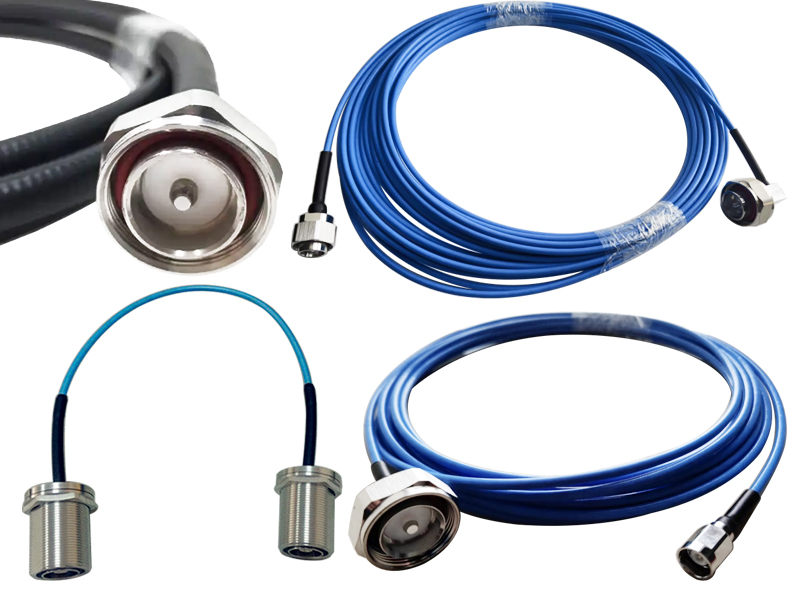
When choosing a cable for use with 7/16 DIN connectors, engineers should carefully evaluate the following factors:
| Factor | Considerations |
| Frequency range | Ensure the cable's loss characteristics are acceptable at your highest operating frequency (7/16 DIN typically used up to 6 GHz) |
| Power handling | Larger cables (e.g., LMR-900, RG-218) handle more power; smaller cables (e.g., LMR-400) have lower power limits |
| Attenuation / Loss | LMR-600 and LMR-900 offer very low loss for long runs; RG-213 offers a good balance of loss and cost |
| PIM performance | For cellular multi-carrier sites, select low-PIM certified cables to prevent interference |
| Flexibility and bend radius | LMR-400 is flexible; LMR-900 and larger are stiffer and require careful routing |
| Outdoor environment | For tower or outdoor installation, choose cables with UV-resistant, water-blocking, and weatherproof jackets |
| Cable diameter | Ensure the connector has the correct ferrule/clamp size for the cable diameter |
| Cost | LMR-400 is cost-effective; LMR-900 and specialized cables are more expensive |
Installation Best Practices
When terminating 7/16 DIN connectors onto coaxial cables, proper installation is critical to achieving specified performance:
Use the correct stripping dimensions: Each cable and connector pair has specific strip lengths for the inner conductor, dielectric, and shield. Follow the manufacturer's instructions precisely.
Use proper tools: Crimp, clamp, or solder termination requires appropriate tools to ensure consistent, reliable connections.
Avoid stress: Support cables to prevent mechanical stress on the connector, especially at the junction point.
Weatherproof connections: Outdoor connections should be taped and sealed with self-amalgamating tape and mastic to prevent moisture ingress and corrosion.
Inspect regularly: For critical infrastructure, periodic inspection and testing (VSWR, PIM) ensure long-term performance.
Commonly Used Cable-Connector Pairings
The following table summarizes the most common 7/16 DIN connector to coaxial cable pairings in practice:
| Cable Type | Typical Application | Frequency Range | Power Handling (Typical) | Remarks |
| LMR-400 | Small cell, DAS, short jumper | Up to 6 GHz | ~100–200 W | Most common, excellent balance of performance and cost |
| LMR-600 | Medium-length tower feeds | Up to 6 GHz | ~200–300 W | Lower loss than LMR-400 |
| LMR-900 | Long-distance base station feeds | Up to 6 GHz | ~300–500 W | Ultra-low loss, used for high-power systems |
| RG-213 | Amateur radio, broadcast, general RF | Up to 6 GHz | ~100–200 W | Classic, rugged, widely available |
| RG-214 | High-power, interference-prone environments | Up to 6 GHz | ~100–200 W | Double shielded for low interference |
| RG-393 | Military, aerospace, high-reliability | Up to 6 GHz | ~200–300 W | Rugged, high-performance |
| Belden 9913 | Low-loss, high-performance | Up to 6 GHz | ~100–200 W | Equivalent to LMR-400 in performance |
Conclusion
The 7/16 DIN connector is a robust, high-performance interface designed for demanding RF applications. Its compatibility with a range of low-loss, high-power coaxial cables—including the widely used LMR-400, LMR-600, LMR-900, RG402, RG-213, RG-214, and RG-393 families—makes it an essential component in cellular infrastructure, broadcast, and defense systems.
When selecting a cable for termination with a 7/16 DIN connector, engineers must prioritize impedance matching (always 50 Ω), power handling, attenuation, PIM performance, and environmental durability. By choosing the right cable and ensuring proper installation practices, system designers can achieve reliable, long-lasting performance in the most demanding RF environments.