

-
We’re On Call 24/7 : +8613538296050
-
E-mail : anna@rohoconnector.com
We’re On Call 24/7 : +8613538296050
E-mail : anna@rohoconnector.com
In the diverse landscape of RF coaxial connectors, the MHV (Miniature High Voltage) interface occupies a unique niche. Developed as an early high-voltage variant of the ubiquitous BNC connector, the MHV was engineered to handle significantly higher voltages while maintaining a compact, bayonet-coupled form factor. Although largely superseded by safer designs in new equipment, MHV connectors remain widely deployed in legacy instrumentation, nuclear research facilities, X-ray systems, and various laboratory environments where voltages beyond the rating of standard BNC are required.
This blog post provides an overview of the classification and key performance characteristics of MHV connectors.
MHV connectors can be classified based on several criteria: structural configuration, materials and plating, intended application, and voltage rating.
MHV connectors are primarily manufactured in standard plug/jack configurations, with various mounting styles to suit different equipment needs. The connector features two bayonet lugs on the female jack side, with mating fully achieved in a quarter-turn of the coupling nut. Dimensions conform to MIL-STD-348B.
Common mounting configurations include:
Straight plugs and jacks: The most basic inline form.
Right-angle configurations: For tight spaces where cable routing must turn sharply.
Bulkhead receptacles: Designed to mount through a panel.
4-hole panel mounts: For flange mounting directly to equipment chassis.
Feedthroughs (air-side connectors): For vacuum applications, connecting external cables to in-vacuum coaxial lines.
Key to any RF connector classification is its gender:
MHV Plug (Male): Features a protruding center pin. The male plug has slightly protruding insulation that extends beyond the outer contact, a distinguishing feature that prevents mating with standard BNC jacks.
MHV Jack (Female): Accepts the male plug's center pin.
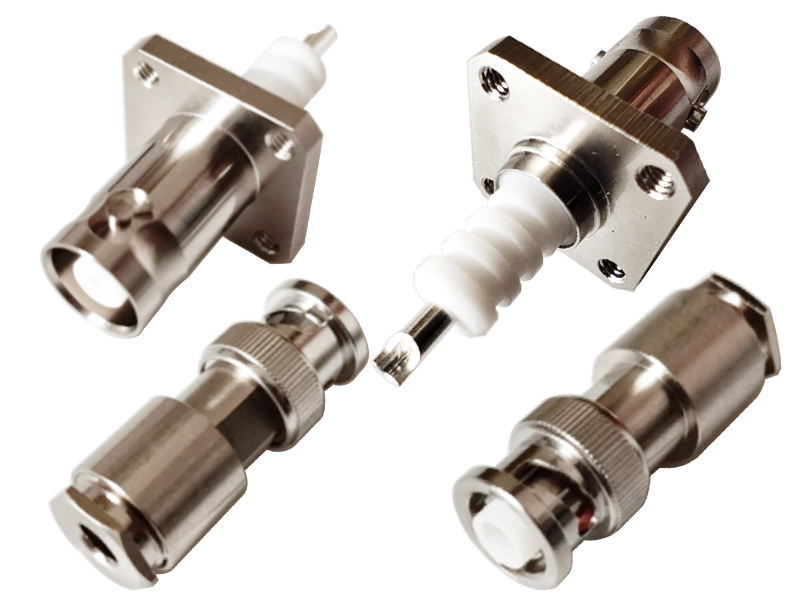
Quality MHV connectors are manufactured from robust materials to withstand high voltages, corrosion, and repeated mating cycles.
Body Material: Typically machined brass for excellent conductivity and mechanical strength.
Plating: Bodies are commonly plated with nickel for corrosion resistance and durability; some are silver-plated for enhanced conductivity.
Center Contact Material: Male center contacts are usually brass, while female center contacts are often beryllium copper for its spring properties. Both are finished with gold plating over a nickel underplating to ensure low contact resistance and prevent oxidation.
Insulator Dielectric: PTFE (Teflon) is the standard dielectric material, selected for its high dielectric strength and excellent thermal stability, enabling use across a wide temperature range.
MHV connectors are engineered for specific high-voltage, low-to-mid frequency uses:
Nuclear Control Instrumentation: Including NIM and CAMAC standards in research laboratories.
High-Voltage Power Supplies: Internal and external cable connections.
X-Ray Equipment: For both medical imaging and industrial inspection.
Transmission Lines: In specialized test setups requiring moderate power handling.
Vacuum Systems: Through MHV coaxial feedthroughs for high and ultra-high vacuum applications.
Medical Diagnostics: Connecting high-voltage signal paths in imaging systems.
Aerospace and Defense: In radar and navigation systems within legacy platforms.
Manufacturers define two critical voltage specifications:
Working Voltage (Continuous): Typically rated for 1500 Vrms (continuous) or 1600 V AC/5000 V DC, depending on the manufacturer's specifications.
Dielectric Withstanding Voltage: Up to 5000 Vrms (AC) or 5000 V peak, representing the momentary overload limit before insulation breakdown occurs.
Special high-performance variants, such as BNC HT (High Temperature) series, achieve even higher ratings; a mated pair can be rated at 10 kV DC.
When evaluating an MHV connector for a system, engineers must assess a set of electrical, mechanical, and environmental parameters.
Peak Voltage: up to 5,000 V.
Working Voltage (continuous): Approximately 1.6 kV AC or 5 kV DC depending on conditions and specific product line.
Current Rating: Typically up to 3 A continuous; some high-performance versions extend to 5 A or 10 A.
Due to their non-constant impedance structure (MHV connectors do not maintain a uniform impedance across their length), their usable frequency range is limited:
Typical specified range: DC to 300 MHz (or 500 MHz).
Precision designs may reach 2 GHz with 50 ohm impedance, though with correspondingly higher manufacturing tolerances.
Below 50 MHz, they are most at home.
The characteristic impedance of MHV connectors is inherently non-constant due to their modified insulation geometry. For precise RF applications requiring strict 50 Ω matching, other families such as N-Type or SMA are preferred. However, many MHV products are designed with nominal 50 Ω impedance and are suitable for video and pulse applications where precise impedance control is less critical.
MHV connectors are not typically specified for very low VSWR, as their primary design goal is voltage handling rather than precision impedance matching. Nevertheless, quality adapters achieve VSWR of 1.2:1 maximum up to 300 MHz. Lower-grade or right-angle connectors may have higher VSWR, e.g., 1.6:1.
Low and stable contact resistance is critical to prevent voltage drop and arcing in high-voltage applications:
Contact resistance inner conductor: ≤ 2 mΩ.
Contact resistance outer conductor: ≤ 1 mΩ.
Insulation resistance: ≥ 5,000 MΩ, ensuring no leakage current between the center conductor and shield.
Quality MHV connectors are built for repeated use. Standard products are rated for a minimum of 500 mating cycles. The bayonet locking mechanism provides a quick, secure connection that resists accidental disconnection.
Typical operating temperature range for MHV connectors spans from -65°C to +165°C (-85°F to 329°F), making them suitable for environments where commercial-grade components would fail.
To fully appreciate MHV connectors, it is essential to understand where they sit among visually similar interfaces:
MHV vs. BNC: Both use bayonet coupling and are similar in size, but MHV connectors have elongated PTFE insulation that protrudes beyond the outer contact. MHV connectors are not mechanically compatible with BNC connectors jacks, despite their appearance. BNC is rated for only 500 V DC, whereas MHV handles up to 5,000 V.
MHV vs. SHV (Safe High Voltage): SHV connectors address a major safety flaw of the MHV: during unmating, MHV interrupts the ground connection before the high-voltage center contact is fully disengaged, potentially exposing an energized pin to the operator's touch. SHV connectors use recessed female contacts and a "ground-before-mate, break-before-ground" sequence to eliminate this hazard. For new designs, SHV or other safety connectors are strongly recommended over MHV.
MHV connectors are not considered safe by modern standards due to their inherent safety hazard. When the connector is unmated, the outer shell (ground connection) disconnects before the high-voltage center pin, which means if the cable remains energized or retains residual capacitance, the exposed center pin can deliver a severe electrical shock. Furthermore, because MHV and BNC share similar geometry, it is physically possible to force an MHV plug into a standard BNC receptacle—potentially routing 5 kV into a 500 V-rated device, causing catastrophic equipment failure.
Due to these inherent risks, MHV connectors are largely considered legacy components and are not recommended for new engineering designs. For new projects requiring high voltage in a compact coaxial format, SHV connectors are the safer alternative.